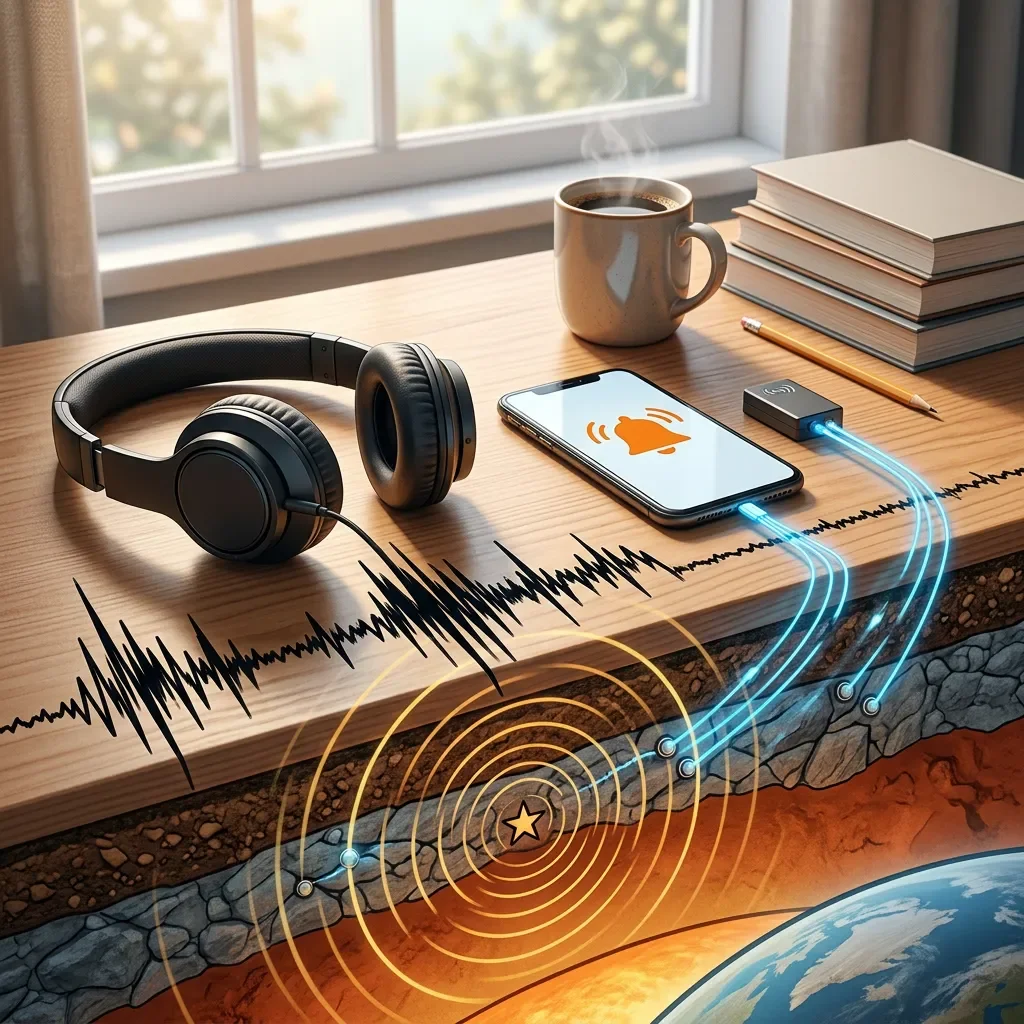
Listening practice: The seconds before the shaking arrives1×0:007:260:00Part One: First Listening2:40Part Two: Chinese Notes and Vocabulary4:49Part Three: Replay0:00主播Imagine you are sitting in a classroom, and a phone suddenly makes a sharp emergency sound. The message says that strong shaking may arrive soon. It may not give you a minute. It may give you only ten seconds, or even less. That sounds almost too short to matter, but in an earthquake, a few seconds can change what people and machines do. According to the U.S. Geological Survey, the ShakeAlert system is not earthquake prediction. It does not know about an earthquake before it begins. Instead, it detects an earthquake after it has already started, estimates where strong shaking may go, and sends a message as fast as possible.0:36主播The key idea is that an earthquake sends out different kinds of seismic waves. According to USGS and Natural Resources Canada, the first waves are called P waves, or primary waves. They travel faster and usually cause less damaging shaking. After them come S waves, or secondary waves, and surface waves, which are slower but generally more damaging. Sensors near the earthquake can feel the first P waves. Their data can travel through communication systems much faster than the shaking waves move through rock. Computers then estimate the earthquake's location, size, and likely shaking intensity. If the earthquake meets alert rules, a warning can be delivered before the stronger shaking reaches some places.1:22主播This is why distance matters. If you are far enough from the earthquake source, the warning message may win a small race against the stronger waves. The Pacific Northwest Seismic Network explains that people may receive an alert up to tens of seconds before shaking, but sometimes the alert may arrive during the shaking, or after it has already begun. If the earthquake starts very close to you, there may be no time for the system to measure, process, and deliver a warning first. Scientists call this a late alert zone. A missed or late alert is not always a simple failure. It can be a limit of physics, distance, sensor density, and communication time.2:00主播So what is the value of a warning that lasts only a few seconds? For a person, it can be enough time to drop, cover, and hold on instead of running toward a door or a window. For a system, it can be enough time to slow a train, open a firehouse door, stop an elevator at the nearest floor, or close a valve. Natural Resources Canada also notes that earthquake early warning cannot replace stronger buildings, drills, and preparedness. It is one layer of protection, not a promise of safety. The important lesson is simple: early warning is not magic. It is a race between information and shaking, and sometimes information is just fast enough to help.2:40中文提示这一遍先抓主线:本期讲的是 earthquake early warning,地震早期预警。它不是 prediction,不是提前预测地震,而是在地震已经开始后,尽快侦测、计算并发出提示。你听英文时要抓住一个对比:信息传得很快,而地震波在岩石里传播相对慢,所以预警系统其实是在和更强的晃动赛跑。3:10中文提示关键词第一组:earthquake,地震;shaking,晃动;seismic waves,地震波;P waves,primary waves,初至波或纵波,速度更快;S waves,secondary waves,横波,速度较慢但通常更具破坏性;surface waves,面波,也会造成明显晃动。注意英文里说 the stronger shaking reaches some places,意思是更强的晃动到达某些地方。3:42中文提示关键词第二组:detect,侦测;estimate,估计;location,位置;magnitude,震级;shaking intensity,晃动强度;sensor,传感器;communication system,通信系统;alert rules,预警规则;deliver a warning,发送预警。这里的 deliver 不是送快递,而是把信息送达用户或系统。4:11中文提示长句抓主干:If you are far enough from the earthquake source, the warning message may win a small race against the stronger waves. 主干是 the warning message may win a small race,预警信息可能赢得一场小小的赛跑。If 引导条件,从震源足够远;against the stronger waves,和更强的地震波赛跑。听第二遍时,重点听清 according to 的来源归属,以及 not prediction, but detection 这个核心对比。4:49主播Imagine you are sitting in a classroom, and a phone suddenly makes a sharp emergency sound. The message says that strong shaking may arrive soon. It may not give you a minute. It may give you only ten seconds, or even less. That sounds almost too short to matter, but in an earthquake, a few seconds can change what people and machines do. According to the U.S. Geological Survey, the ShakeAlert system is not earthquake prediction. It does not know about an earthquake before it begins. Instead, it detects an earthquake after it has already started, estimates where strong shaking may go, and sends a message as fast as possible.5:26主播The key idea is that an earthquake sends out different kinds of seismic waves. According to USGS and Natural Resources Canada, the first waves are called P waves, or primary waves. They travel faster and usually cause less damaging shaking. After them come S waves, or secondary waves, and surface waves, which are slower but generally more damaging. Sensors near the earthquake can feel the first P waves. Their data can travel through communication systems much faster than the shaking waves move through rock. Computers then estimate the earthquake's location, size, and likely shaking intensity. If the earthquake meets alert rules, a warning can be delivered before the stronger shaking reaches some places.6:10主播This is why distance matters. If you are far enough from the earthquake source, the warning message may win a small race against the stronger waves. The Pacific Northwest Seismic Network explains that people may receive an alert up to tens of seconds before shaking, but sometimes the alert may arrive during the shaking, or after it has already begun. If the earthquake starts very close to you, there may be no time for the system to measure, process, and deliver a warning first. Scientists call this a late alert zone. A missed or late alert is not always a simple failure. It can be a limit of physics, distance, sensor density, and communication time.6:48主播So what is the value of a warning that lasts only a few seconds? For a person, it can be enough time to drop, cover, and hold on instead of running toward a door or a window. For a system, it can be enough time to slow a train, open a firehouse door, stop an elevator at the nearest floor, or close a valve. Natural Resources Canada also notes that earthquake early warning cannot replace stronger buildings, drills, and preparedness. It is one layer of protection, not a promise of safety. The important lesson is simple: early warning is not magic. It is a race between information and shaking, and sometimes information is just fast enough to help.