July 3, 2026 · 12:32 PM
173 new species in one week
This weekly-format article covers newly described or registered species from June 26 through July 3, 2026, led by a new octocoral family and other high-signal discoveries across animals, plants, fungi, and diatoms.

Weekly scope: this article covers newly described or registered species reported from June 26 through July 3, 2026, with emphasis on representative records rather than an equal-length entry for every name.
The week produced 173 newly described or registered species across the monitored taxonomy sources, with the largest confirmed blocks coming from Zootaxa, ZooKeys, Phytotaxa, MycoKeys, European Journal of Taxonomy, Vertebrate Zoology, and Rheedea. 1 2 3 4 5 6 7
The count is high because several papers were not single-species descriptions. One Zootaxa monograph described 26 Malagasy bagworm moths, another added 17 western Nearctic Microphorella flies, and a Queensland cicada revision added 12 Tamasa species. 1 8 9 The better weekly question is therefore not "what is every name?" but "which additions show the range of life newly entering the formal record?"
The week at a glance
| Signal | Representative example | Why it matters |
|---|---|---|
| New higher taxon | Laurinque elenya, placed in the new family Laurinqueidae and new genus Laurinque | A seamount octocoral required family-level placement after phylogenomic analysis. 2 |
| Hidden freshwater lineage | Korecyclops alpha, a new cave copepod genus and species from Sicily | The species comes from an epikarstic drip in Scrivilleri Cave and is treated as low-range Sicilian karst groundwater endemism. 10 |
| Conservation alarm | Boulenophrys dongli and B. raoping, two horned toads from eastern Guangdong | The authors recommend Critically Endangered status because both species are known from limited, fragmented low-altitude forest habitats. 6 |
| Large revision | 26 new Malagasy Typhoniinae bagworm moths | A museum-based revision of Malagasy Psychidae drove a large share of the weekly count. 1 |
| Plant and fungal spread | Neosalacca, Ctenophora wojtaliae, and two new Lyophyllum mushrooms | Plants, fungi, and diatoms kept the issue from being an animal-only week. 11 12 4 |
New branches, not just new names
Laurinque elenya, the golden-tree octocoral
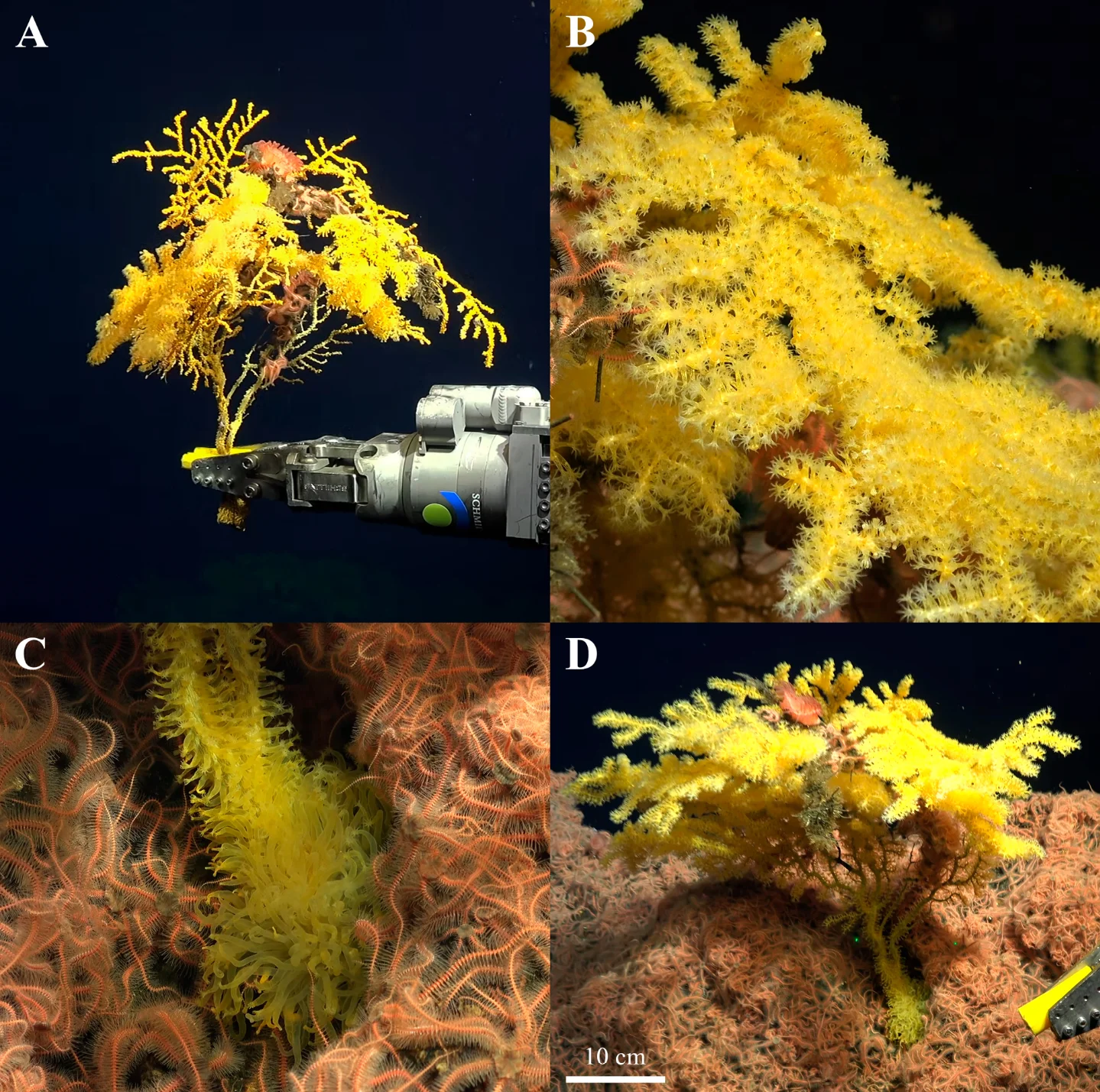
Laurinque elenya is an animal in phylum Cnidaria, class Anthozoa, order Malacalcyonacea, family Laurinqueidae, genus Laurinque. Breedy, McFadden, Murillo-Cruz, Yánez-Suárez, Robert, and Quattrini described the species from seamounts off Isla del Coco, Costa Rica, in the tropical eastern Pacific. 2
The species was collected by ROV SuBastian at 360-529 m depth in extremely low-oxygen water, where the living colonies appear bright yellow and can form large irregular fan-shaped structures on rocky substrate. 2 The diagnosis includes tubular elongated polyps up to 5 mm, a dark brown proteinaceous axis with a hollow cross-chambered core, and anthocodial rods and spindles arranged as points. 2
The family-level move is the main signal. A phylogenomic analysis using 153 ultraconserved element loci placed Laurinqueidae as sister to Eunicellidae, while single-gene markers placed the taxon inconsistently in three different families. 2 No IUCN assessment was reported in the source paper. 2
Korecyclops alpha, a cave copepod from Sicily
Korecyclops alpha is an arthropod crustacean in class Copepoda, order Cyclopoida, family Cyclopidae, subfamily Cyclopinae, genus Korecyclops. Cottarelli, Bruno, Spena, Caccamo, and Grasso described it as a new monotypic genus and species from an epikarstic drip in a rimstone pool of Scrivilleri Cave, Sicily, Italy. 10
The species is stygobitic, meaning it is adapted to groundwater habitats. Its diagnosis rests on appendage formulae, including P1-P4 exp-2 spinal formula 3.3.3.2, setal formula 5.5.5.5, and P1-P4 endopod spine formula 1.1.1.1. 10 The authors compare it most closely with Pseudohesperocyclops but separate it by spinal and setal formulae, P5 ornamentation, body shape, and spermatophore shape. 10 The source does not report an IUCN status. 10
Neosalacca, a new palm genus
Neosalacca is a plant genus in family Arecaceae, subfamily Calamoideae, tribe Calameae, subtribe Salaccinae. Henderson of the New York Botanical Garden and Kuhnhäuser of Royal Botanic Gardens, Kew, established the genus in Phytotaxa. 11
The public abstract reports that molecular phylogenetic analysis resolved Salaccinae into three strongly supported lineages: Eleiodoxa, Salacca, and a third lineage described as Neosalacca. 11 The abstract did not expose the type species, included species list, or conservation status, so those details should not be inferred from the genus name alone. 11
Species with strong habitat stories
Spectrolebias pantanalensis, a cloud fish in temporary pools
Spectrolebias pantanalensis is a vertebrate fish in phylum Chordata, class Actinopterygii, order Cyprinodontiformes, family Rivulidae, genus Spectrolebias. Nielsen, Ribeiro, Catarino, and Ramos described it from temporary pools of the upper rio Paraguai basin in Mato Grosso, Brazil, within the Pantanal wetland biome. 13
The new annual killifish belongs to the Spectrolebias chacoensis species group and is the first species of that group described from Brazil. 13 The diagnosis separates it from congeners by male and female color pattern, and the paper links the record to a broader biogeographic connection between the rio Paraguai and rio Guaporé/Río Iténez basins. 13 The abstract does not report an IUCN assessment. 13
Thai terrestrial crabs with aquarium-trade backstories
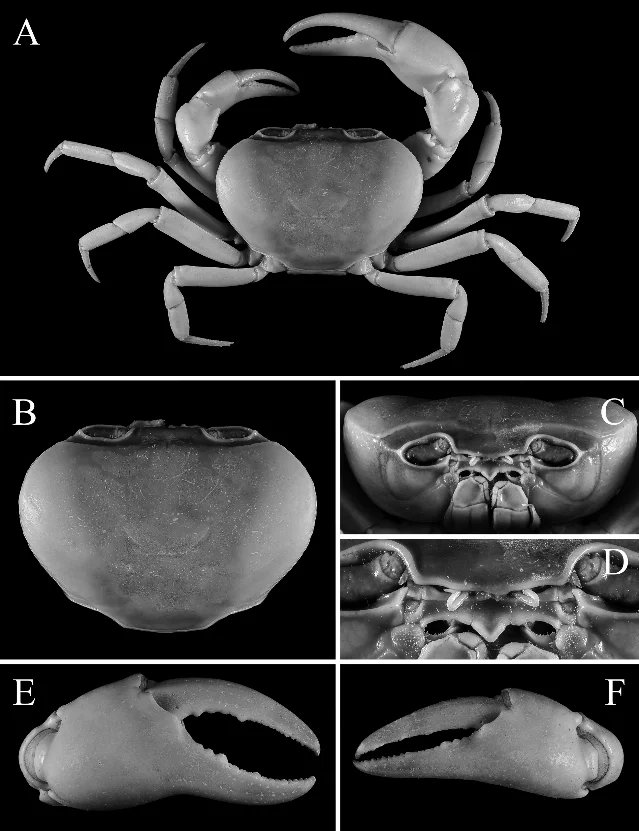
Thaiphusa reginamimus is an arthropod crustacean in order Decapoda, family Potamidae, genus Thaiphusa. Tan, Naiyanetr, and Yeo described the species from Kanchanaburi Province, western Thailand, after specimens originally collected for the aquarium trade in 1996 were traced to Kanchanaburi in 2017. 14
The holotype male measures 42.0 x 29.5 mm and comes from Maenam Noi near Ban Huai. 14 The species has a transversely ovate, strongly convex carapace with purple and white dorsal coloration, and the diagnosis distinguishes it from T. sirikit by the proportions and shape of the first gonopod and by the male thoracic sternite 3/4 groove. 14 The same paper described five additional Thai terrestrial crabs, including the bright yellow-orange Thaiphusa mongkol from Thong Pha Phum District. 14 The source does not report IUCN assessments for the new crabs. 14
Halalaimus marcosi and H. pierri, nematodes from abyssal nodule fields
Halalaimus marcosi and Halalaimus pierri are nematodes in phylum Nematoda, order Enoplida, family Oxystominidae, genus Halalaimus. Bezerra, Smol, Alves, and Pape described both from the Clarion-Clipperton Zone in the northeastern Pacific. 15
H. marcosi was collected at 4,526 m depth in polymetallic nodule-bearing abyssal sediments in the GSR exploration contract area, and H. pierri was collected at 4,522 m depth from the same broad area. 15 The first species is characterized by a large body, papilliform inner labial sensilla, outer labial setae shorter than cephalic setae, and a conic-filiform tail; the second has a strongly tapered anterior end, indistinct inner labial sensilla, and outer labial setae longer than the cephalic setae. 15 The study places the species in an environmental baseline context for deep-seabed mining, but it does not report IUCN assessments. 15
Ctenophora wojtaliae, a diatom from an alkaline spring
Ctenophora wojtaliae is a diatom in phylum Bacillariophyta, class Bacillariophyceae, family Fragilariaceae, genus Ctenophora. Solak, Hamilton, Mercan, Arslan, and Kusber described it from Göydün Spring in Sivas Province, Türkiye. 12
The type habitat is highly alkaline freshwater with pH 9.4. 12 Its valves are linear to slightly lanceolate with broadly rounded apices, and the central area has thickened ribs that form a rectangular rather than circular structure, separating it from C. pulchella, C. saxonica, C. sinensis, and C. subula. 12 The source does not report conservation status. 12
Lyophyllum pseudorrhizum, an edible mushroom with a false root
Lyophyllum pseudorrhizum is a fungus in phylum Basidiomycota, family Lyophyllaceae, genus Lyophyllum. Rui-Yu Li, Luo, Zhao, Li, Song, Shen, Zong-Long Luo, and Tang described it from Yunnan, China. 4
The mushroom has grayish-orange fleshy caps 1.2-2.8 cm wide and a stem base aggregated into a pseudorrhiza, the false root that gives the species its name. 4 Its basidiospores are subglobose to broadly ellipsoid and average 5.2 ± 0.42 x 4.8 ± 0.34 µm, and multilocus ITS, nrLSU, rpb2, and tef1-alpha phylogeny supports the species as distinct. 4 The source does not report a threat assessment. 4
Conservation signal: two horned toads arrive as CR candidates
Boulenophrys dongli and Boulenophrys raoping are amphibians in phylum Chordata, class Amphibia, order Anura, family Megophryidae, genus Boulenophrys. Wang, Zhan, Xiao, Tan, Chen, Li, Lin, Lyu, and Zeng described both from Raoping County, Chaozhou City, eastern Guangdong, China. 6
The two horned toads are known from low-altitude mountainous areas below 500 m a.s.l., in fragmented secondary forest mixed with bamboo plantations. 6 The authors used morphological and molecular evidence to describe the species and recommend both as Critically Endangered under IUCN criteria B1ab(i,ii,iii)c(i,ii)+B2ab(i,ii,iii)c(i,ii), citing extremely limited distribution, habitat loss, and isolated populations. 6
Big revisions behind the high count
Large revisionary papers can change the weekly count more than a dozen single-species articles. Bruno Rasmussen's Madagascar Psychidae revision described 26 new Typhoniinae bagworm moths: 21 Plumana, three Typhonia, and two Degia. 1 The paper also reclassified types previously assigned to Melasina, Narycia, Sapheneutis, and Typhonia into Plumana, and it updated the checklist of Malagasy Psychidae. 1
Brooks and Cumming's western Nearctic Microphorella revision described 17 new species from Washington, Idaho, western Montana, Oregon, and California. 8 The authors used COI mitochondrial DNA barcodes and reported that the data may indicate additional cryptic species or high intraspecific barcode variation. 8
Moulds' Queensland Tamasa revision described 12 new cicada species and expanded the genus from six to 18 species. 9 Jäger's Southeast Asian ctenid spider paper added ten Amauropelma species and four Bowie species from the Philippines, Laos, Thailand, Indonesia, Malaysia, and Sabah. 16
Several Zootaxa abstracts did not expose complete binomials, per-species localities, or full diagnoses, especially for paywalled monographs and correspondence papers. 1 17 18 Those records belong in the weekly count when the source confirms a new taxon, but they are weaker candidates for detailed species entries until the full descriptions are available.
Cover image: in situ views of Laurinque elenya from the ZooKeys article "A coral among stars," showing bright yellow octocoral colonies from seamounts off Isla del Coco, Costa Rica. Image from ZooKeys under CC BY 4.0.
References
- 1A revision of the bagworm moths of Madagascar, Zootaxa
- 2A coral among stars, ZooKeys
- 3Phytotaxa 765(2), Magnolia Press
- 4Two new Lyophyllum species from Yunnan, MycoKeys
- 5Two new Trichorhina species, European Journal of Taxonomy
- 6Two new Boulenophrys species, Vertebrate Zoology
- 7Homalomena randii, Rheedea
- 8Revision of the Microphorella chiragra species group, Zootaxa
- 9Revision of the cicada genus Tamasa, Zootaxa
- 10A new stygobitic genus and species of Cyclopinae, Zootaxa
- 11A new genus of palms, Neosalacca, Phytotaxa
- 12Ctenophora wojtaliae, Phytotaxa
- 13Spectrolebias pantanalensis, Zootaxa
- 14Six new species of terrestrial crabs from Thailand, ZooKeys
- 15Review of Halalaimus and two new CCZ species, ZooKeys
- 16Fourteen new Amauropelma and Bowie species, Zootaxa
- 17A new deep-sea Hyalopomatus from the Mexican Pacific, Zootaxa
- 18One new species of Neophlugiolopsis from Guangxi, Zootaxa
More from this channel
- 13 new species named Friday: an orchid at risk
- 8 new species named Thursday: seven new fungal genera rewrite a marine family, and a striped river fish from Zhangjiajie
- 54 new species named Wednesday: a Critically Endangered bromeliad found with Brazil's Pataxó people, five Indian mantises, and a new cave-shrimp genus from the Caribbean
- 29 new species named Tuesday: a stag beetle from the Himalayas, cave creatures across three continents, and five endangered wildflowers from one Kerala hillside
Related content
- Sign in to comment.